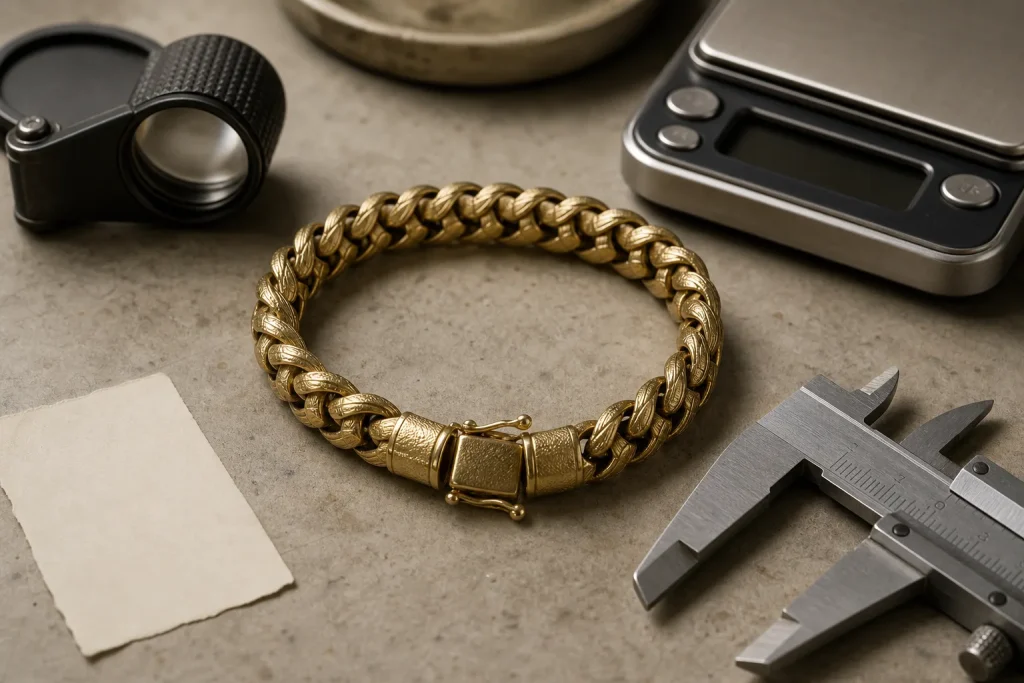
An 18K RGP bracelet is usually not valued as a solid-gold bracelet. The mark commonly points to an item with an 18K gold-colored or gold-alloy outer layer, but it does not, by itself, prove how much gold is present, what metal is underneath, or what a buyer will pay. Its value may be modest as metal, or higher as wearable, vintage, branded, or collectible jewelry. Source (accessed 2026-08-25)
Start with the mark, not the bracelet’s total weight
Read the stamp as two separate pieces of information. 18K describes the stated fineness of the gold layer or gold material referred to by the marking. RGP is commonly used for “rolled gold plate.” In U.S. jewelry-marking guidance, terms such as rolled gold plate, gold-filled, and gold plate are construction terms with conditions for their use; they are not interchangeable with a claim that an entire article is solid gold. Source (accessed 2026-08-25)
That distinction is the reason a per-gram solid-gold calculation is usually the wrong starting point. A scale measures the whole bracelet: clasp, base metal, possible stones, and the outer finish. It does not identify the amount of recoverable gold in that total weight.
What “RGP” can and cannot tell you
| Mark or description | What it suggests | What still needs confirmation |
|---|---|---|
| 18K RGP | A stated 18K gold layer or finish associated with rolled-gold-plate terminology. | The core metal, layer thickness, whether the mark is original, and the bracelet’s actual gold content. |
| Solid gold mark | A claim about the article’s gold fineness. | Whether the mark is accurate and whether every component is the same material. |
| Gold-filled or rolled-gold description | A mechanically applied gold layer under jewelry-marking terminology. | The specific construction and whether the item meets the conditions associated with that description. |
| Gold-plated description | A surface layer of gold over another material. | The underlying metal and the amount of gold present. |
| Gold over silver | A claim that the base may be silver. | Whether the silver is actually sterling or another alloy, unless a separate silver quality mark or test supports it. |
The Federal Trade Commission’s jewelry guidance distinguishes gold-content and gold-layer descriptions, including terms used for mechanically applied gold layers and plated articles. It also addresses representations of silver quality. That is why an RGP stamp alone should not be treated as proof that the bracelet is silver underneath. Source (accessed 2026-08-25)
If you find another mark beside RGP, record it exactly rather than relying on memory. A maker’s name, country mark, silver-quality mark, patent notation, or model reference can be more useful for resale research than the RGP letters alone. For help organizing marks, materials, and visual clues, see how to search for jewelry by mark, material, and value.
How to identify your bracelet without damaging it
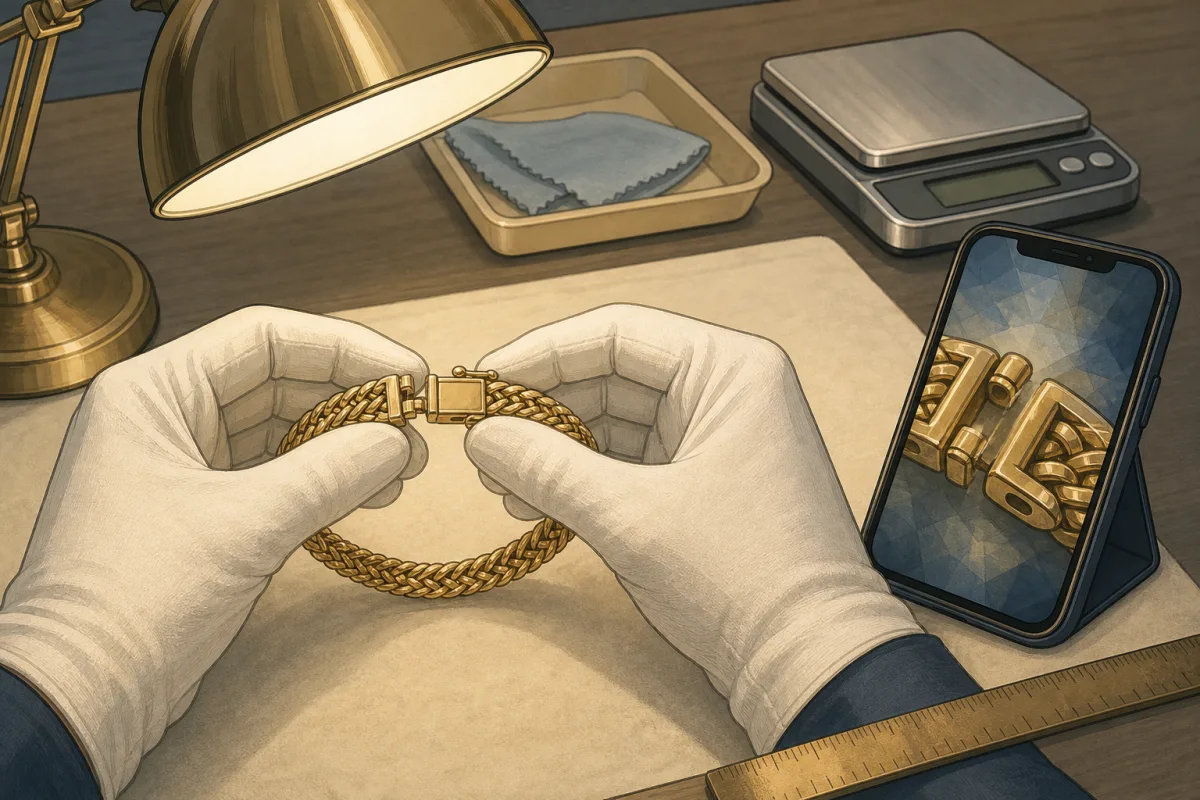
- Photograph the marks. Take close, well-lit photos of the clasp, end caps, back of decorative panels, and any hang tag. Include a full-bracelet photo and clear images of wear.
- Measure and weigh it. Note the length, width, total weight, clasp type, and whether it feels hollow or solid. Treat the weight as a description for comparable listings, not a gold-content calculation.
- Inspect high-friction areas. Look at the clasp, links, edges, and underside. Color changes, exposed gray metal, green corrosion, or flaking can indicate a worn finish and affect resale appeal.
- Use a magnet only as a screening clue. Attraction can suggest that a ferrous component is present, but no attraction does not prove gold, silver, or a particular construction. Do not advertise a magnet result as authentication.
- Seek non-destructive professional evaluation when the answer matters. A jeweler, precious-metal buyer, or assay service can explain what their testing can identify and whether the expected resale benefit justifies the fee.
Avoid filing, aggressive acid testing, or scraping a visible area at home. These methods can reduce the bracelet’s collectible and wearable value, while a result from a surface layer may not settle the question of the core. If the bracelet may be a stronger gold-layer construction, compare it with the distinctions in this gold-filled jewelry value article before selling it as ordinary plated jewelry.
Use the right kind of value
“Worth” can mean several different things. Keeping them separate prevents a disappointing sale or an inflated online expectation.
- Scrap or melt value: the amount a refiner may assign to recoverable precious metal. This is often limited for an item whose gold is only a surface layer.
- Core-metal value: a separate possibility only when a silver or other valuable core is confirmed. Do not assume a silver core from RGP alone.
- Private-party resale value: what a buyer may pay to wear, collect, repair, or repurpose the bracelet.
- Marketplace asking price: the seller’s request. It is not evidence that the item sold at that amount.
- Dealer or pawn offer: a buyer’s business offer, which can reflect testing risk, resale effort, condition, and the buyer’s local demand.
A bracelet can be worth more than costume-jewelry value when it has a desirable maker, a documented age, an appealing design, a confirmed silver core, exceptional workmanship, matched pieces, original packaging, or demand from collectors. Conversely, heavy wear, missing stones, stretched links, anonymous mass production, and uncertain materials can keep the likely resale value modest even when the finish looks bright.
A practical valuation workflow
- Create a fact sheet from your photos: every stamp, dimensions, weight, condition, maker, and any paperwork.
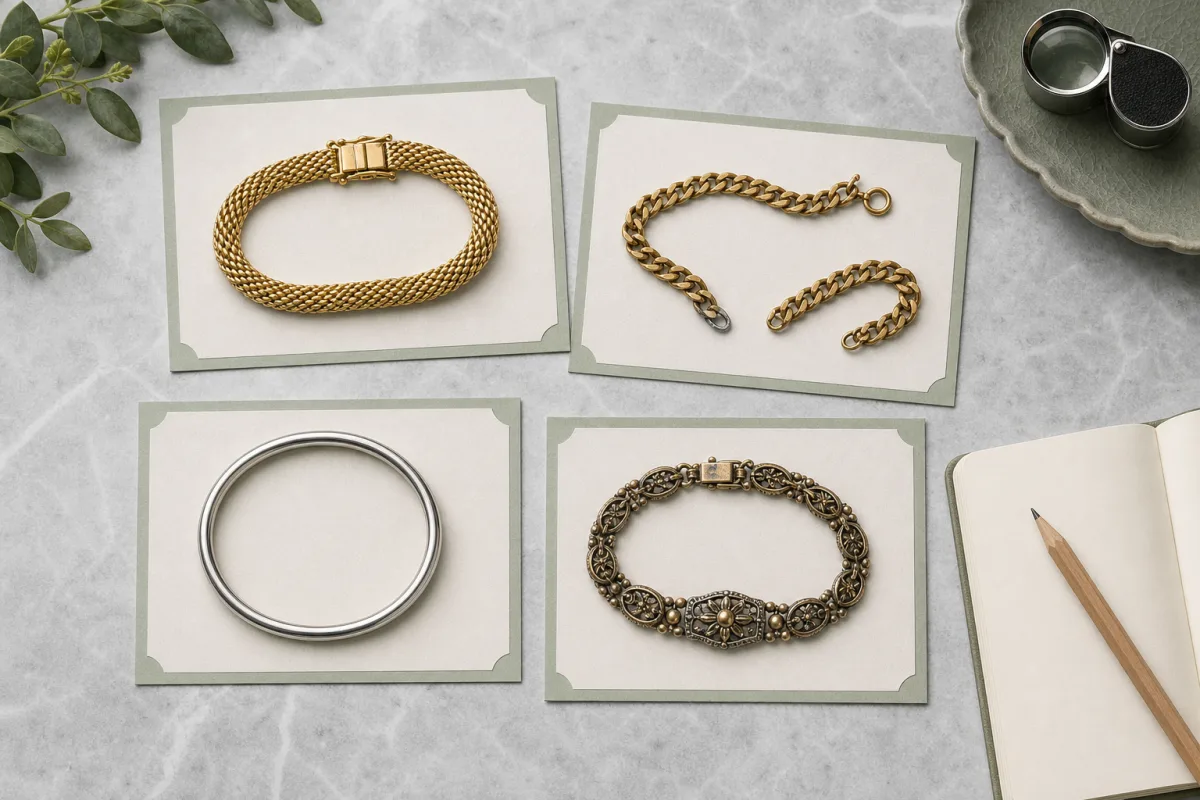
- Search completed sales for closely comparable bracelets, matching construction, maker, design, condition, and completeness. Ignore listings that are merely active or use vague “gold” wording.
- Separate comparables into likely solid gold, gold-filled or rolled-gold items, plated items, and confirmed silver-core items. Do not blend these categories into one average.
- Request more than one offer if you intend to sell. Tell each buyer the exact RGP mark and disclose repairs, missing parts, wear, and test results.
- Compare the best offer with the effort and cost of further testing or appraisal. A formal appraisal is most useful when identification, insurance, estate documentation, or a potentially important maker is involved.
For a confirmed solid-gold hallmark, the interpretation is materially different from RGP. Our article on gold jewelry marked with a fineness stamp explains why a fineness mark and a gold-layer mark should not be valued the same way.
Is an 18K RGP bracelet pawnable?
It may be accepted by a pawnshop or dealer, but acceptance is not guaranteed and should not be taken as confirmation of gold content. A buyer may decline an item with uncertain construction, make an offer based on resale potential, or request testing and clear disclosure. Bring the bracelet clean but unaltered, along with close-up mark photos, provenance, receipts, and any prior test documentation. Ask what the offer is based on: confirmed metal, expected resale, brand, or condition.
Do not describe it as solid gold unless qualified testing and marks support that description. “Marked 18K RGP” is clearer and protects both you and the buyer from a misunderstanding.
When is professional testing worth pursuing?
Consider it when the bracelet carries a recognizable maker mark, appears antique or unusually well made, has a separate silver-quality mark, has a substantial or distinctive design, or has documentation that suggests a more valuable construction. If it is visibly worn, unmarked beyond RGP, and readily comparable to low-demand fashion jewelry, ask about the testing cost before proceeding. Testing should answer a question that could realistically change your selling channel or expected return.
The bottom line
An 18K RGP bracelet can be attractive and saleable, but the stamp does not establish a solid-gold per-gram value. Verify additional marks and construction, assess condition and design, use completed—not merely advertised—comparables, and obtain multiple informed offers. The bracelet is most likely to exceed ordinary fashion-jewelry value when its maker, age, workmanship, confirmed underlying metal, or collector demand gives a buyer a reason to value more than the gold-colored finish.