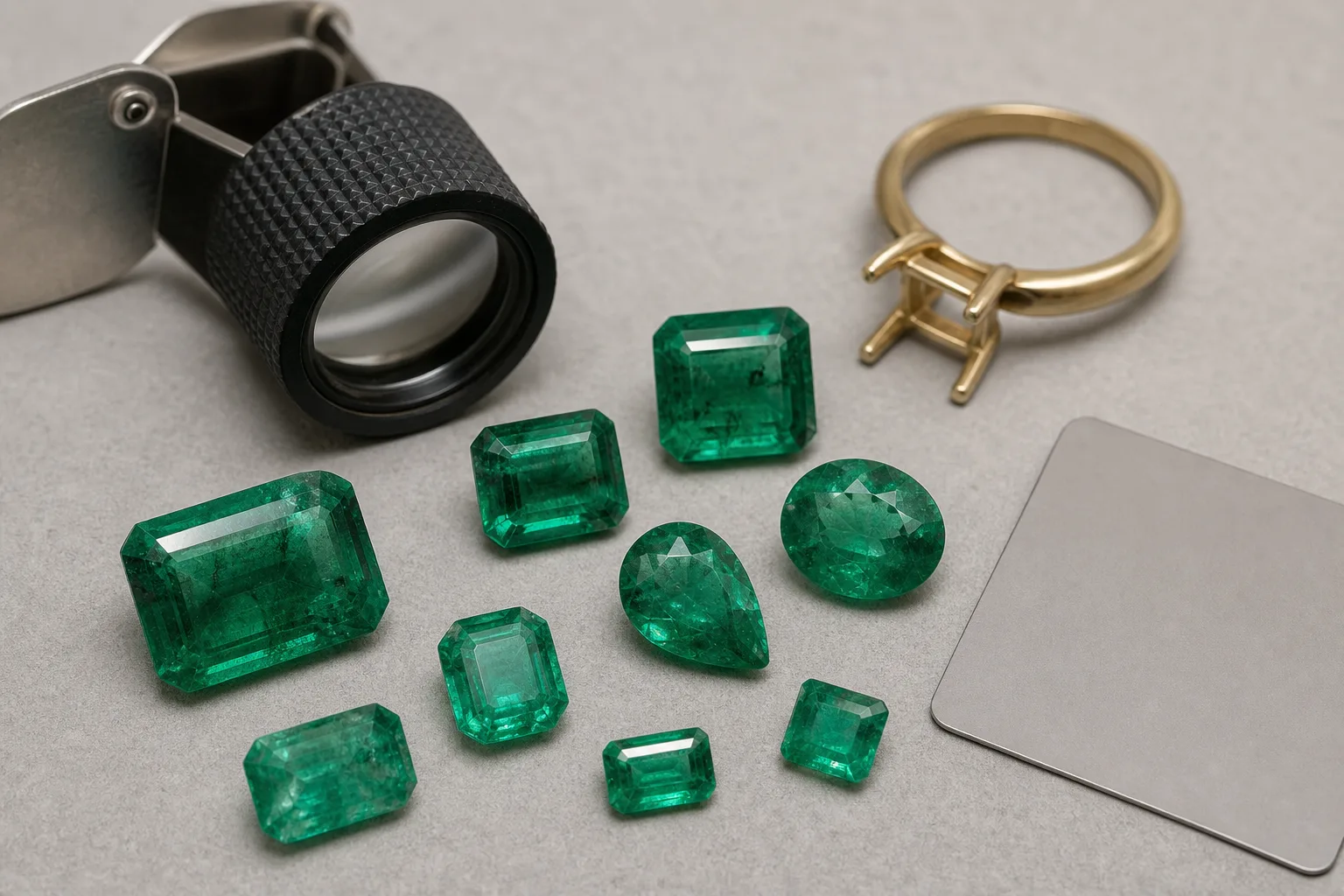
The price of emerald per carat can range widely because color, transparency, treatment, size, and documentation can change the value of two same-weight stones dramatically. As a practical starting point for loose natural stones, published consumer-facing ranges place commercial material around $100–$500/ct, good or fine material around $700–$2,500/ct, and higher-quality material around $2,500–$6,000/ct. These are broad comparison bands, not an appraisal, and exceptional gems can sit well outside them. https://rubyglint.com/emerald-value-calculator — accessed 2026-08-04
First separate what you are comparing: a natural emerald, a laboratory-grown emerald, a loose stone, and an emerald ring are not interchangeable pricing categories. A retail asking price is also not the same thing as a resale, trade-in, auction, or insurance-replacement value.
Loose natural emerald price bands
Use these bands only after confirming that the stone is natural and after asking about clarity enhancement. They are best used to narrow a research range before an in-person gem examination or laboratory report. https://rubyglint.com/emerald-value-calculator — accessed 2026-08-04
| Loose natural emerald category | Illustrative price per carat | What commonly separates it |
|---|---|---|
| Commercial | $100–$500/ct Source — accessed 2026-08-04 | Often lighter, darker, grayish, noticeably included, or more heavily enhanced. |
| Good or fine | $700–$2,500/ct Source — accessed 2026-08-04 | More attractive green, better brightness, and a more balanced appearance. |
| Higher-quality | $2,500–$6,000/ct Source — accessed 2026-08-04 | Stronger green color and more desirable overall appearance; documentation and treatment level matter greatly. |
At the exceptional end, published dealer education describes very fine emeralds at $10,000–$30,000 per carat, while other published education notes that extraordinary material may exceed $100,000 per carat. Those figures describe a rare end of the market, not a default expectation for an emerald ring or an unidentified stone. https://emeraldsandjewelry.com/blogs/price-for-emeralds/price-for-emeralds-and-emerald-jewelry — accessed 2026-08-04 https://emeralds.com/education/price-of-an-emerald/ — accessed 2026-08-04
What common carat weights might mean
The following totals are arithmetic illustrations based on the published bands above, assuming a loose natural stone. They do not establish the value of a particular emerald. Per-carat prices are not linear: as a stone becomes larger and retains attractive color and clarity, its per-carat rate can rise. https://rubyglint.com/emerald-value-calculator — accessed 2026-08-04
| Weight | Commercial illustration | Good or fine illustration | Higher-quality illustration |
|---|---|---|---|
| 0.5 ct | $50–$250 Source — accessed 2026-08-04 | $350–$1,250 Source — accessed 2026-08-04 | $1,250–$3,000 Source — accessed 2026-08-04 |
| 1 ct | $100–$500 Source — accessed 2026-08-04 | $700–$2,500 Source — accessed 2026-08-04 | $2,500–$6,000 Source — accessed 2026-08-04 |
| 2 ct | $200–$1,000 Source — accessed 2026-08-04 | $1,400–$5,000 Source — accessed 2026-08-04 | $5,000–$12,000 Source — accessed 2026-08-04 |
| 3 ct | $300–$1,500 Source — accessed 2026-08-04 | $2,100–$7,500 Source — accessed 2026-08-04 | $7,500–$18,000 Source — accessed 2026-08-04 |
Why two same-weight emeralds can have different prices
Color is usually the first visual value driver
Look beyond the word “green.” Hue describes the basic color; saturation describes intensity; tone describes lightness or darkness. Buyers commonly seek a lively, vivid green that is neither overly dark nor overly pale. A stone can have an attractive size yet price modestly if it looks grayish, yellowish, bluish, sleepy, or too dark. The effect must be judged in person or from reliable, consistently lit images.
Inclusions are expected, but their visibility matters
Emeralds commonly contain inclusions. Their presence alone does not make a stone poor quality; what matters is whether they reduce transparency, beauty, durability, or the cutter’s ability to produce an appealing face-up appearance. A cleaner-looking emerald with comparable color can command a materially different price from a more visibly fractured or cloudy stone. https://www.gemsociety.org/article/emerald-jewelry-and-gemstone-information/ — accessed 2026-08-04
Treatment disclosure changes the comparison
Clarity enhancement is an important part of emerald valuation. Ask whether fractures have been filled, the type of filler used, and the reported degree of enhancement. Do not compare an emerald described as minor enhancement directly with one that has significant filling unless the difference is reflected in the price. A credible report or seller disclosure helps, but it should be read alongside the stone’s actual appearance. https://www.gemsociety.org/article/emerald-jewelry-and-gemstone-information/ — accessed 2026-08-04
Origin can support value, but it is not a shortcut
Origin descriptions such as Colombian can affect demand, particularly when backed by a respected laboratory report. Origin alone does not guarantee a high price: color, clarity, cut, size, treatment, and report credibility still determine whether the stone is desirable. Treat an unsupported origin claim as a seller description, not as proof.
Natural, laboratory-grown, loose, and mounted: keep categories separate
A laboratory-grown emerald may resemble a natural emerald visually, but it is a different market category and should be explicitly identified as laboratory-grown or synthetic in listings and comparisons. Do not apply natural-emerald price bands to it.
A ring’s price is also more than its center stone. The metal weight and fineness, side diamonds, workmanship, brand, condition, and whether the setting can be resold all affect the result. For clues from marks and materials, see the site’s jewelry search method, gold stamp article, and white-gold value notes.
Retail is an asking market: it can include merchandising, warranty, returns, financing, and overhead. Resale and trade-in offers are purchase offers from a buyer who must cover risk and resale costs. Auction results can be useful comparables when the lot description, treatment disclosure, weight, quality, and sale terms are genuinely similar. Insurance-replacement values serve a different purpose again and should not be used as a likely cash-sale figure.
A practical estimate method for LumaGem research
- Identify whether the item is loose or mounted, and record the stated stone weight and measurements.
- Record the visible color in neutral light: hue, saturation, tone, and any obvious grayness or darkness.
- Read every receipt, report, and listing note for natural versus laboratory-grown status, treatment, and claimed origin.
- Compare only stones with the same category: loose with loose, natural with natural, and similar treatment levels.
- Apply a broad per-carat band, then add the setting’s separate metal and diamond considerations if the stone is mounted.
- Use the result as a research range, not as a purchase offer, resale quote, or insurance appraisal.
When using LumaGem or any image-led identification result, keep the original photos, report text, dimensions, and mounting details together. A photo cannot reliably establish treatments, origin, or all durability concerns. For more context on comparing jewelry information, browse the Jewelry Value Guides.
Price per gram conversion
Gemstones are normally quoted per carat. A carat equals 0.2 grams, so a per-gram figure can be calculated by dividing a per-carat price by 0.2. Conversion does not make unlike emeralds comparable; it only changes the unit. https://www.gemsociety.org/article/emerald-jewelry-and-gemstone-information/ — accessed 2026-08-04
Buyer-safety questions to ask before paying
- Is the emerald natural or laboratory-grown?
- What treatment or clarity enhancement is disclosed?
- Is the stated origin supported by a report, and which laboratory issued it?
- Is the price for a loose stone or for finished jewelry?
- Can the seller provide clear, consistent photos and the exact weight and dimensions?
- What are the return terms, and can you compare genuinely similar stones before the return window closes?
For a meaningful individual estimate, gather the weight, measurements, clear face-up and side photos, color observations, inclusion visibility, treatment disclosure, report details, origin claim, and whether the stone is loose or set. Those facts are more useful than a single universal emerald price per carat.